Sign In
Upcoming Event
 Free Newsletter

How The Nuclear Company in Columbia aims to combat the US’s looming energy crisis
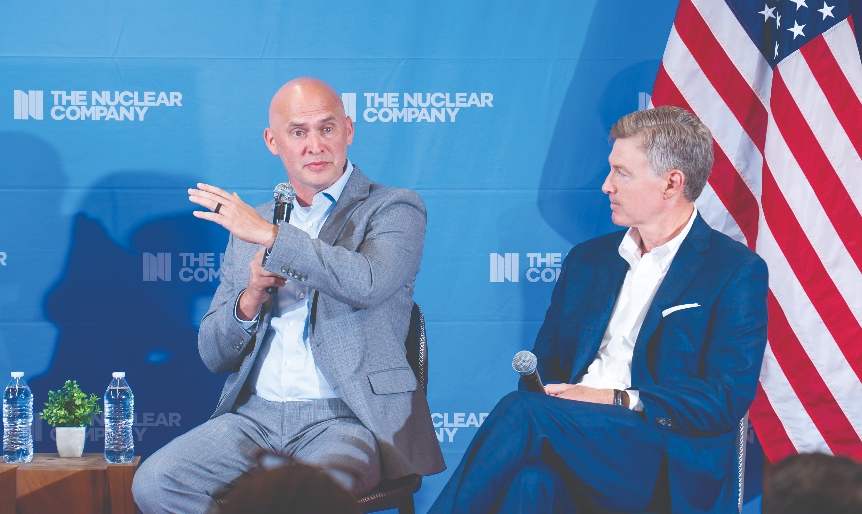
The Nuclear Company Chief Nuclear Officer Joe Klecha, left, speaks during a stop by The Nuclear Frontier national campaign in 2024 at Nucor’s headquarters in Charlotte. (Photo/The Nuclear Company)|The Nuclear Company Chief Nuclear Officer Joe Klecha, center, visits Georgia Tech’s nuclear engineering program during a stop by The Nuclear Frontier national campaign in July 2024. (Photo/The Nuclear Company)
The Nuclear Company Chief Nuclear Officer Joe Klecha, left, speaks during a stop by The Nuclear Frontier national campaign in 2024 at Nucor’s headquarters in Charlotte. (Photo/The Nuclear Company)|The Nuclear Company Chief Nuclear Officer Joe Klecha, center, visits Georgia Tech’s nuclear engineering program during a stop by The Nuclear Frontier national campaign in July 2024. (Photo/The Nuclear Company)
How The Nuclear Company in Columbia aims to combat the US’s looming energy crisis


- The Nuclear Company opens HQ in Columbia, creating 100+ jobs
- Company aims to combat U.S. electricity shortfall with nuclear power
- Fleet-based reactor model targets safer, faster construction
- AI-driven energy demand pushing need for gigawatt-scale solutions
When The Nuclear Company decided to bring its primary engineering and construction offices to Columbia in April, its officials shared some information that not many Americans may be aware of — the nation is on the cusp of an energy crisis.
That term is familiar mostly to people of a certain age who remember oil embargoes and gas shortages dating back to the 1970s, but this looming crisis has to deal with electricity. As everything from cars to manufacturing demands more of it, the U.S. isn’t generating enough of it, nor is it exploring ways to do so quickly or effectively enough.
The Nuclear Company wants to change that through its goal of modernizing nuclear construction through a “fleet-based” approach that will allow for the construction of nuclear plants in a safer, faster and more uniform manner, resulting in a deployment of nuclear power to more places across the U.S. that need it. The company’s new office is expected to create more than 100 jobs as the company looks for sites for its initial six-gigawatt fleet of nuclear reactors.
Explaining the need for nuclear power and how more of it can be brought on line faster might seem complicated to most people, but the company perhaps couldn’t have picked a better person to talk about its mission than chief nuclear officer Joe Klecha.
A native of Maine, Klecha brings decades of experience in the nuclear industry to his current role. Over the course of his career, he’s managed projects valued at more than $35 billion and built by teams of more than 11,000.
Klecha served as fleet operations director for Duke Energy, overseeing six nuclear power stations. Earlier in his career, he worked in leadership roles for more than a decade at Constellation, where he oversaw 2.2 gigawatts of nuclear power generation as a licensed senior reactor operator, and did extensive work at the Vogtle units run by Southern Co. in Georgia.
He came to the commercial nuclear industry after nearly a decade in the U.S. Navy, where he led operations of a nuclear reactor and steam propulsion plant, as well as a deep submergence nuclear research submarine, and earned seven Navy Achievement Medals. He holds a bachelor’s degree in nuclear engineering technology from Thomas Edison State University and an MBA from Duke University.
Klecha recently took time to talk about The Nuclear Company and its mission with SC Biz News.
What first drew you to the nuclear industry?
I first started serving on my first nuclear submarine in 1995 and I really fell in love with the engineering magnificence of nuclear energy, how uranium could be converted into energy that acted as the propulsion for submarines and aircraft carriers. Then, after I concluded my navy career and got my degrees, I moved into my first jobs with large nuclear power plants and learned more about the industry. I really just enjoyed the great responsibility that comes with operating those facilities and the magnificent amount of power those facilities can generate.
What is the greatest need that The Nuclear Company is trying to address?
This country currently has a large and growing energy demand, and we’re at the tipping point of an energy crisis. The need is coming from the increased electrification of technology, increased needs from manufacturing and — probably the biggest one of the past couple of years — the revolution in artificial intelligence. Studies show we are going to need to add 200 to 300 gigawatts over the next 25 years, and the only real solution is building more nuclear plants. We decided yes, we have to move forward with nuclear plants whether large or small, and we want to help build them using proven technologies. We want to become the best in the industry at deploying these assets, and work to compress the schedule and compress the cost while building plants that are safer and of better quality. That’s really the problem we’re trying to solve, and we strongly believe we don’t have to have all the answers if we do it while working with great partners.
As an example of the need being generated by AI, a lot of the current data centers are operating at 500 megawatts up to 1 gigawatt — and large nuclear reactors have traditionally been between 1 and 1.4 gigawatts. Just because of the power it takes for computation, these data centers are getting bigger and bigger and there will likely be a day when AI projects could need up to 10 gigawatts. That’s 10 large nuclear power plants just supporting that data center. AI needs nuclear, and nuclear needs AI.

What was the thinking behind bringing the company’s headquarters to Columbia?
First off, the need for energy and the demand in the Southeast is one of the highest in the country. There’s a massive need for large amounts of power with lots of business and industry moving to the area, and this was a great market for us to go to. South Carolina has been, is and will continue to be a leader in nuclear power generation. The state is currently third in nuclear generation in the U.S. and we would like to make it number one on that list. There’s a great amount of support for the industry that extends throughout this state, from the government to the communities to the universities. It’s the place where a nuclear renaissance can really take off.
Could you explain the “fleet-based” model of building nuclear reactors?
Traditionally, one site would be built by a single utility. They’d bring in partners to build that site, with generally two different units at the site that would meet their needs, and then look at building another 10 or 20 years later. With fleet scale, we don’t do one or two — we look at six or eight reactors on two or three different sites, using the same technology and the same partners. You lock the design for that plant down, and you’re basically rinsing and repeating from one unit to the next. You’re able to use the same methodologies, the same craft and crews and leaderships, and be able to work much more efficiently.
It’s a similar approach to what you might see in home development. Developers will line houses up and move from one site to another, building the same designs in repetition and really maximizing efficiency. With this approach in the nuclear industry, we can put in an order for eight reactors instead of two. This has a lot of advantages for us and for our partners.
Despite all the advancements in nuclear energy over the years, there are still many people who question the industry’s safety. How do you respond to those questions?
Having worked in nuclear almost my whole professional career, I can say it’s the safest industry I’ve ever been around as far as the level of professionalism and nuclear safety culture. Everybody working at these facilities has the right mindset, is willing to challenge and question things when necessary and has the ability to raise issues without concerns of retaliation. The nuclear industry is a great cultural community where people are continuously learning. However, as an industry we have not done a good job educating people on just how safe it is and the great benefits nuclear energy brings to communities. We’ve let movies and media take the narrative. These plants continue to get safer and the current level of safety adds magnitudes to what was already a very safe product.
We believe in being totally transparent about the process and being good stewards in our community. It’s important to build relationships in the community both through helping educate people about nuclear power through things like welcome and education centers at nuclear plants, and also sharing information at the high school and college level to help people understand what their career paths could be in the industry.
Where does the United States stand in comparison to other nations when it comes to nuclear power?
We’ve been the leader in the nuclear industry all along, and we still have over 90 operating plants nationwide, but at one point we had more than 100 and we kind of took our foot off the pedal as we saw grid demand leveling off. There wasn’t a lot of need for a while and we’ve lost our stronghold in the industry because of that and because we stopped doing the research and development. For a while there wasn’t the market need we’re seeing now. Now China is really aggressive, adding 10 gigawatts a year. They have more than 40 units planned for construction and more than 10 currently in construction. They’ve gotten good at the fleet scale model and if we don’t start moving very quickly we’re going to lose our position as the leader in nuclear energy generation. It’s a national security issue that we need to solve to get our country moving in the right direction.
l