Sign In
Upcoming Event
 Free Newsletter

SCbio CEO lays the groundwork for future life sciences industry growth
Hollie Moore // February 21, 2025//
SCbio CEO lays the groundwork for future life sciences industry growth
Hollie Moore // February 21, 2025//


South Carolina is the sixth-fastest growing life sciences industry in the U.S., following competitive markets in the northeast such as Massachusetts, New Hampshire and Rhode Island.
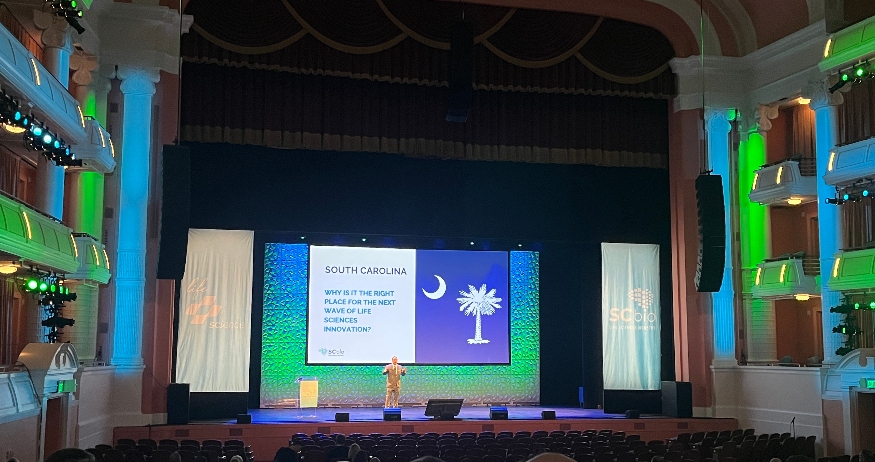
James Chappell, president and CEO of SCbio, announced the ranking at the organization’s recent Annual Conference featuring speakers from companies across the United States in the life sciences industry.
Chappell discussed the elements working together in the state to create such a fast-growing hub. One of the top influencers was Blue Sky Labs and the innovation district it represents, as well as the Medical University of South Carolina, the University of South Carolina and Clemson University.
“We have all of this data to show that what we are talking about is real,” Chappell said. “We are in the process of moving from growth to leadership.”
One of Chappell’s goals is for the talent coming out of the state’s main universities to have a direct pipeline into South Carolina’s life sciences industries rather than looking elsewhere.
Chappell said in order to continue the growth, there needs to be infrastructure such as more wet and dry lab space, as well as “cutting-edge” equipment for new companies coming into the state.
“We have to make sure that our companies, especially the ones in the growth stage, are ‘derisked’ as much as possible,” Chappell said. “We need to help them get connected with a CFO or CMO that will help them grow to help them focus on the science and curing that terrible disease.”
Alan Andress, senior manager for Deloitte Consulting, said South Carolina’s life sciences industry is going strong, but there is room for growth.
The top three trends affecting the life sciences industry, he said, are rising prices and regulatory changes, a shift toward personalization and precision medicine, and the rise of data in the digital age of research and development.
“Making sure that people are aware of the regulatories of how to show up for day one is incredibly important,” Andress said. “But also making sure that the Ph.D.’s and the bright people coming out of the universities understand it’s not just about the science.”
Andress said after seeing everything going on in the state, he was impressed by the talent coming out of the universities and the move being made for space such as Blue Sky Labs.
Considering manufacturing “a win for the state,” Andress suggested the life sciences industry start to take more advantage of the well-established manufacturing market.
Related: Charleston event shines spotlight on South Carolina’s life sciences sector
Related: South Carolina Aquarium unveils new waterfront facility in Charleston
“Crafting the incentives is going to be essential,” Andress said. “Whether it’s access to offset compute costs, offset energy costs or data asset as well, making sure there is a governance to say there are benefits to the state and there is benefit in job creation.”
As politics change, Arda Ural, from the U.S.’s industry market leader Ernst & Young, said there will also be effects on the U.S. life sciences industry. Global trade policy and tariffs risk impacting pharmaceutical and MedTech sectors.
Additionally, Ural predicts inflation from tariffs will impact prices and vaccines could also take a hit. On a positive note, he said the life sciences industry should benefit from tax policies extending corporate tax cuts and as well as tax policies impacting U.S. companies.
“We have to find a way to grow, innovation cannot stop because diseases do not stop,” Ural said.
C