Sign In
Upcoming Event
 Free Newsletter

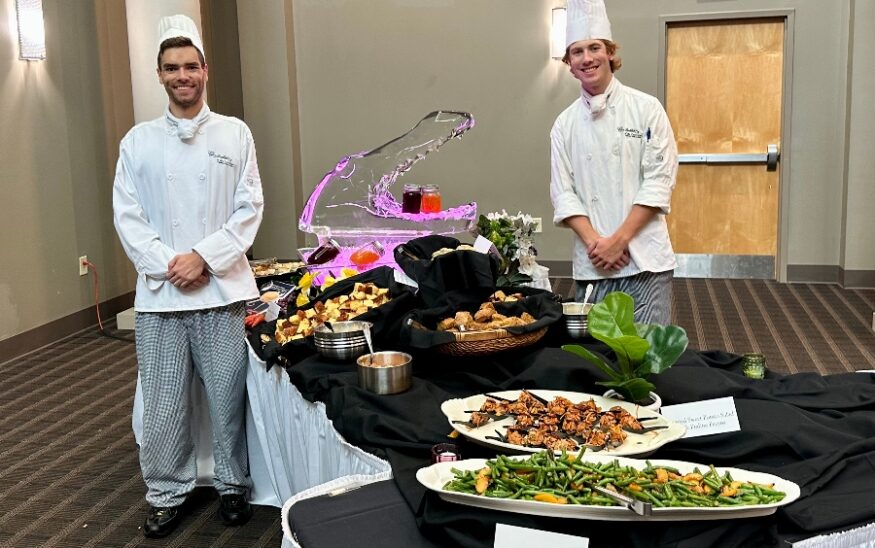
Will Nelms, right, and Ben Hidde, left, at Greenville Technical College's Culinary Institute of the Carolinas, which recently underwent a rebrand. (Photo/Culinary Institute of the Carolinas)
Will Nelms, right, and Ben Hidde, left, at Greenville Technical College's Culinary Institute of the Carolinas, which recently underwent a rebrand. (Photo/Culinary Institute of the Carolinas)
How Greenville Tech’s Culinary Institute feeds Greenville’s food economy


- Culinary Institute of the Carolinas updates brand to match Greenville Tech’s new identity
- Program has graduated 685 students since 2007
- Greenville’s food scene gains national attention and Michelin interest
- CIC graduates lead award-winning restaurants, fueling local economy
The Culinary Institute of the Carolinas (CIC) at Greenville Technical College recently unveiled a refreshed brand identity to underscore its role as a leading center for world-class culinary education.
“Greenville Technical College rebranded last year, so we felt this was the right time to give the CIC a new look to align with the college’s new brand,” said Beth Thomason, public information director at Greenville Technical College.
Chef Kristen Grissom, CIC department head, said that the update goes beyond aesthetics. “Our rebrand is more than a new look — it’s a reflection of who we are and the level of excellence we bring to culinary education,” she said.
Rising enrollment and resilience
According to Grissom, the CIC has been growing steadily and has produced 685 graduates since 2007-08, demonstrating resilience and adaptability over the past 17 years. “We showed steady growth from 2007-2012, going from 19 graduates to 49, with the highest number of graduates recorded in 2017-18 (57).”
After surviving a pandemic-induced dip, the CIC saw graduation totals rebound, with numbers holding steady at approximately 42 graduates each year.
“Our focus is on continuing to grow those numbers,” said Grissom.
Fueling the culinary momentum
Prior to joining the CIC, Grissom worked in the pastry department at the Ritz Carlton in Orlando and then developed the baking and pastry program at Daytona State College.
“I’ve always loved the Greenville area for its natural beauty and family friendly environment,” Grissom said.
What Grissom noticed during the 13 years since she’s been in the Greenville area is that the culinary scene has grown dramatically.
“We are seeing a surge in restaurant openings,” she said, adding that an area that was once known for its “meat and threes” is now gaining prestige in the culinary world.
Greenville Mayor Knox White said that restaurants have put Greenville on the map.
“They are a huge part of what makes downtown Greenville an award-winning and welcoming place,” he said.
A standout example of a success story is CIC graduate Joe Cash, who went to New York to work at Per Se before returning to Greenville head the kitchen at Scoundrel. Under his leadership, the French-inspired downtown brasserie earned a James Beard semifinalist nod for Best New Restaurant in 2024.
Knox said that the CIC is a valuable asset to the area.
“Many of the restaurants in the City of Greenville have talented chefs who are CIC graduates,” he said, “This talent pipeline is essential in providing the variety of options we have in the city and creating opportunity for the graduates to improve their economic wellbeing.”
Grissom explained that Greenville is much like the little engine that could when compared to well-established culinary hubs like Charleston, for instance.
“Our food culture is emerging and we’re seeing a lot of global cuisine now, along with takes on home-grown low country favorites combined with Appalachian cuisine, which give us plenty of opportunity to expand. The possibilities here are endless,” she said.
It doesn’t hurt that Michelin announced recently announced it will launch an “American South” guide this year to include Alabama, Tennessee, Mississippi and, of course, the Carolinas. Word has it that their anonymous inspectors have been spending some time in Greenville as of late.
“We’d love to be involved and are always looking for that next big opportunity,” said Grissom.
A culinary training ground
The culinary program is housed at Greenville Tech’s Northwest Campus in a state-of-the-art facility designed to mirror real-world culinary environments. It contains five fully equipped commercial-grade kitchens, a dedicated baking and pastry shop and advanced culinary technology. Students are immersed in a professional setting from day one. Classes are capped at 22, allowing for personalized one-on-one instruction.
Grissom envisions the CIC as a go-to resource for local hospitality employers.
“Our advisory board meets two times a year and we are in contact with many different sectors of hospitality. We would like to keep as much talent in this area as we can,” she said.
Grissom also advises her students to maintain a high degree of professionalism at all times.
“As big as the area is, it really is a small industry and people talk — so if you mess up, they’ll know it,” she said.