Sign In
Upcoming Event
 Free Newsletter

Dock Blocks goes all-American with US-made products
Hollie Moore // April 23, 2025//


-
Dock Blocks shifts all production to the U.S. to combat foreign costs
-
Company sees growth in commercial and government dock sales
-
Innovative floating docks sold in the U.S., Israel and the Caribbean
-
U.S. production enables faster delivery and reduced freight tariffs
After 15 years and about 6,000 sales, a Lowcountry dock manufacturing company is taking a step to combat the cost of foreign production and create a Carolinas-made product.
Dock Blocks began in 2010 after Matt West, president of Dock Blocks, purchased the patent for the plastic dock concept from the Brazil-based company he worked for at the time.
When the company started, the team was selling directly to individual consumers for personal boats. Mike Eastman, vice president of sales for Dock Blocks, said today they also target their product to business sales with multiple units ranging from Charleston marinas to government and military agencies.
Over the past few months, North Charleston-based Dock Block has brought the nuts and bolts, the last of the materials made overseas, to manufacture in the United States, West said. The purpose of the transition is to reduce lead time and freight costs and now, the additional risk of tariffs.
Being completely U.S.-produced allows Dock Blocks to be a preferred vendor with the government, West said.
“We do a lot of product innovation, product development and product testing, and I think that’s taken us from a startup company 10 years ago to probably the leader in the industry,” Eastman said. “We’re competing against a lot of companies who have been around for a lot longer than we have and we’ve been able to catch them and pass them through our innovation and testing.”
Today, 40% of Dock Blocks’ sales are commercial, with more than 20,000 units sold, Eastman said. West said their product is in almost every marina in Charleston and the biggest market so far in 2025 has been the military.
Eastman said recently the team has been working on a project in Israel. He said traffic issues in the country are creating excessive travel times and the Dock Blocks team is looking to put helicopter pads in the water for customers to fly to jobs and business meetings.
Israel is not Dock Blocks’ first work outside of the United States. Within the past few years, Eastman said the product has been sold in the Caribbean, Panama, Mexico, Costa Rica, The Bahamas, Jamaica and Turks and Caicos.
Related: West Coast apparel brand opens first SC location in downtown Charleston
Related: Entrepreneur puts down roots with Charleston brick-and-mortar store
For West, one of the perks of the job is seeing people enjoy their boating experience more.
“It can be a real headache. You hear the term ‘best days of owning a boat are the day you buy it and the day you sell it,’” West said. “We try to add some days in between those.”
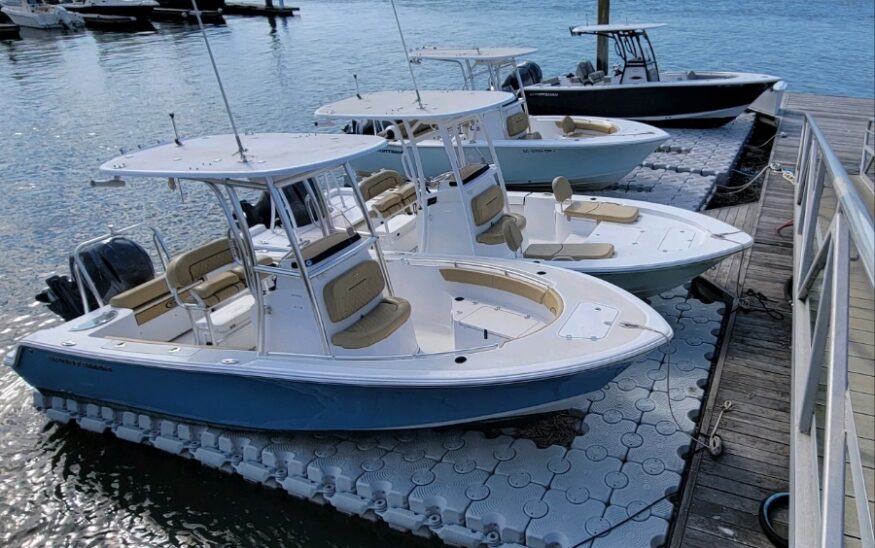
When compared to traditional wooden docks, Eastman said Dock Blocks are less inclined to splintering and cracking, which extends the product’s lifespan. Each customer receives the dock to assemble themselves, avoiding installation time and fees, Eastman said.
In the plastic dock industry, Dock Blocks has a few other competitors, but its thicker plastic, strengthening bars and block connecting pins placed in the middle of each block put it above other competition, the company says.
Additionally, for areas like Charleston where most boats are in saltwater, Eastman said people typically have to bottom paint their boats each year. Dock Blocks are designed to pull the boats out of the water to avoid that additional maintenance.
“We provide a way for people to get under the water and enjoy a better life and a better product for their needs,” Eastman said. “It seems kind of silly in a way, that we make blocks; I call them adult Legos. But if you look at it and see the benefits it gives to people, and the happiness that it provides, it’s a good feeling.”
F