Sign In
Upcoming Event
 Free Newsletter

OPINION: Why stagflation fears may be overblown in today’s economy
Stephen Slifer // August 13, 2025//
(Illustration/DepositPhotos)
(Illustration/DepositPhotos)
OPINION: Why stagflation fears may be overblown in today’s economy
Stephen Slifer // August 13, 2025//


- Economists warn of stagflation, but data suggests otherwise
- Inflation and GDP growth near Fed targets
- Unemployment steady at 4.2%, signaling labor market health
- Fed expected to keep rates steady, possible cut by year-end
More and more economists are suggesting that the economy is about to enter a period of “stagflation,” which is characterized by a combination of high inflation, stagnant economic growth and high unemployment.
 We disagree with all three parts of that description. That said, the reality is that all economists are trying to assess the outcome of policy changes introduced by the Trump Administration. The imposition of tariffs, layoffs of federal government workers, and the deportation of thousands of migrant workers has complicated the issue. Economists love to rely on history as a guide, but in this case there are no comparable periods to help us.
As a result, we are all largely guessing.
In addition to uncertainty regarding the economic situation, Trump is attempting to politicize the Fed by stacking the deck with people who share his view that interest rates are far too high. The Fed is currently correct in keeping the federal funds rate steady. What happens next depends upon whether a stagflation scenario actually unfolds.
With respect to inflation, the consensus is that tariffs are going to boost the prices of many imported products. That is true to some extent. But consumers presumably will shift their purchases to a lower-priced domestically produced good. In a weighted measure of inflation, such as the personal consumption expenditures deflator, greater weight will be given to the lower-priced good, which should keep that measure of inflation in check.
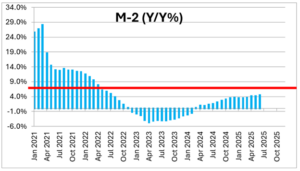
In our opinion, a prolonged increase in inflation will occur only if the Fed lets the money supply grow too quickly — such as occurred in the 2020-2021 period. At that time the Fed purchased several trillion dollars’ worth of U.S. Treasury securities, creating considerable surplus liquidity in the economy, money growth exploded, and inflation soared.
The Fed then shrank its portfolio for a protracted period, money growth declined, the surplus liquidity largely disappeared, and inflation slowed considerably. After declining for a couple of years, slow money growth has returned. In the past year its growth rate has been 4.5%. In the past six months it has been 5.4%, and in the past three months it has been 6.7%.
The Fed seems intent on getting money growth back to its long-term average pace of around 6.0%. As long as it continues on that course, we do not envision any long-term pickup in inflation.
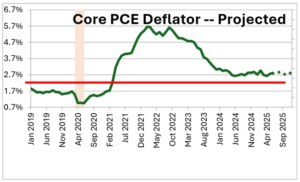
The Fed expects the core personal consumption expenditures deflator to increase 3.1% this year and then slow to 2.4% in 2026. We peg it at 2.8% this year and 2.4% next year. The Fed targets growth in this inflation measure at 2.0%. While it is likely to grow at a pace slightly faster than desired, it is unlikely to accelerate. That does not sound like a problem with the “-flation” part of the stagflation concept.
GDP growth contracted by 0.5% in the first quarter as Trump’s initially announced tariffs scared consumers and business leaders alike. With the first-quarter decline in GDP, the year-over-year growth rate slowed considerably relative to the 2.5% growth rate registered in 2024. Economists generally view that as evidence that the economy has slowed considerably. But second-quarter growth rebounded to 3.0%. And, while it is still early, third-quarter growth seems likely to climb by 2.5%. It appears to us that tariff policies had a major negative impact on growth early in the year, but since then trade agreements and the lowering of most tariff rates from what they were initially have mitigated much of that fear.
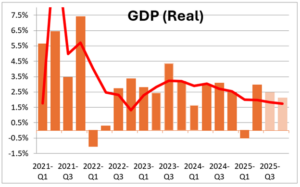
The Fed believes that the long-run potential GDP growth rate is 1.8%. With the GDP decline early in the year, it expects GDP growth of 1.4% in 2025. We peg it at 1.8%. That does not seem to fit with the “stag” part of the stagflation scenario.
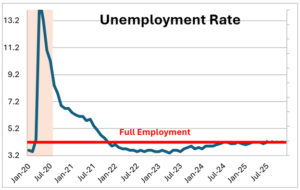
Finally, the unemployment rate currently is 4.2%. While employment growth has slowed, so too has growth in the labor force. As a result, the unemployment rate has been quite steady. The Fed believes the full-employment level of the unemployment rate — the rate at which everybody who wants a job has one — is 4.2%. It expects the unemployment rate to be 4.5% at the end of 2025 and 2026. We expect it to be 4.2% at the end of both years. Any way one slices it, the economy does not appear to be headed for any significant problem in the labor market, which is the third leg of a stagflation scenario.
With the inflation rate, GDP growth, and the unemployment level currently not far from what the Fed would like to see, it seems justified in maintaining the funds rate in a range from 4.25–4.5%. That said, the Fed seems eager to ease and anticipates a 0.5% reduction in the funds rate by year-end. It already has two FOMC members wanting to cut rates immediately, and with the addition of Trump ally Stephen Miran at the September 16–17 FOMC meeting there may be three Fed officials leaning in that direction. But that meeting is still five weeks away. To justify a September easing move, the Fed needs to see evidence that the economy has slowed further, the unemployment rate is definitively on the rise, and/or the inflation rate is subsiding. We do not think that any of those things are likely to happen, but time will tell.
From 1980 until 2003, when he retired, Stephen Slifer served as chief U.S. economist for Lehman Brothers in New York City, directing the firm’s U.S. economics group along with being responsible for forecasts and analysis of the U.S. economy. He has written two books on using economic indicators to forecast financial moves and previously served as a senior economist at the Board of Governors of the Federal Reserve in Washington, D.C. Slifer can be reached at www.numbernomics.com.