Sign In
Upcoming Event
 Free Newsletter

Economist Stephen Slifer says stronger economic fundamentals and modest Federal Reserve rate hikes should keep the U.S. economy out of recession. (Photo/DepositPhotos)
Economist Stephen Slifer says stronger economic fundamentals and modest Federal Reserve rate hikes should keep the U.S. economy out of recession. (Photo/DepositPhotos)
GDP growth — not as soft as it seems
Stephen Slifer // August 3, 2026//


- Stephen Slifer forecasts third-quarter GDP growth of 3.5% despite weaker second-quarter results.
- He expects the Federal Reserve to raise interest rates by 0.5 percentage points before year-end.
- Slifer says inventory reductions and trade deficits distorted second-quarter GDP growth.
- He believes modest Fed rate hikes are unlikely to push the U.S. economy into recession.
 Last week we learned that second quarter GDP growth was 1.5% which was somewhat below the expected 2.0% pace. This was widely interpreted as confirmation that the economy is still slogging along at a subpar pace.
Our spin is somewhat different.
Second quarter growth was dragged down 0.7% as businesses continue to deplete their inventory levels. The deficit for real net exports widened dramatically and subtracted an additional 1.0% from second quarter growth. These are both volatile categories and could easily add as much to third quarter growth as they subtracted from the second quarter. For what it is worth our first crack at third quarter GDP growth is 3.5%. That is hardly anemic.
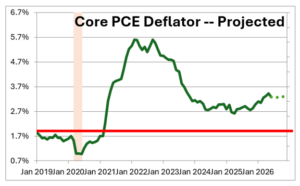
On the inflation front the core personal consumption expenditures deflator rose 0.1% in June but its year-over-year growth rate is 3.3% which remains far above the Fed’s 2.0% target. Against this background it is not surprising that the Fed is poised to tighten soon. But when will the Fed begin to raise the funds rate? September. How high might the funds rate go? Probably 0.5% higher. Could it push the economy over the edge into recession? No.
The 1.5% second quarter GDP growth rate was dragged down 0.7% as businesses continue to deplete their inventory levels. But this is always a particularly volatile category and it could easily turn upwards and add as much to third quarter growth as it subtracted from the second quarter.
At the same time the deficit for real net exports widened dramatically and subtracted an additional 1.0% from second quarter growth. This, too, is a volatile category and could add another significant chunk to GDP growth in the third quarter.
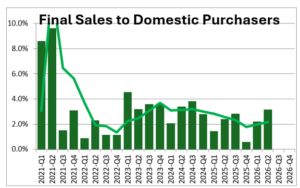
Final sales to domestic purchasers which deletes both inventories and trade grew at an impressive 3.1% rate in the second quarter. In other words consumers and businesses continue to spend but at the moment a significant portion of their purchases are from overseas. Our forecast for final sales to domestic purchases in the third quarter is 3.8%. Back to back growth rates of 3.1% and 3.8% do not appear anemic to us.
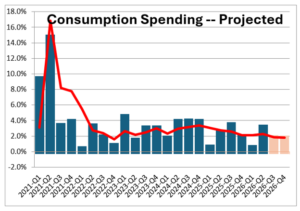
Many economists point out that growth is not widespread. True. Consumer spending has been a driving force. But now with employment beginning to rise income growth is also likely to accelerate which gives consumers more spending power. Ditto for the core inflation rate which may edge its way lower between now and yearend. We expect consumer spending for the year to be 1.8%.
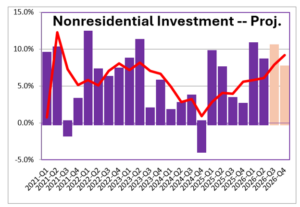
Growth is also being supported by business spending on computer hardware and software related to the AI build out. But that spending is likely to continue at a brisk pace for years to come. We expect GDP growth to average 2.3% this year but accelerate to about 3.0% in subsequent years.
The Fed’s preferred inflation gauge, the core personal consumption expenditures deflator, rose just 0.1% in June but its year-over-year growth rate is currently 3.3% and it is likely to remain close to that pace at yearend.
The Fed chose not to raise rates at the meeting this week but three FOMC members wanted to raise the funds rate immediately. With third quarter GDP growth likely to be 3.5% and the inflation rate somewhat higher as the recent increase in oil prices filters its way into the data, the first increase in the funds rate will almost certainly occur in September with another increase in December (after the election). Against this background it is somewhat puzzling that the Fed did not raise rates at its meeting this week. But apparently Chair Warsh does not yet have the votes to do so. Remember that a couple of months ago the Fed was contemplating an easing move in the second half of the year. Not everybody is on board with such a quick turnaround in the outlook for interest rates.
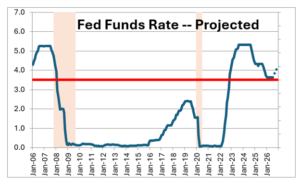
How high might the Fed raise the funds rate? The funds rate currently is in a range from 3.5-3.75%. Two 0.25% rate hikes by yearend would boost that to 4.0-4.25%. At the moment the Fed’s median forecast for a “neutral” funds rate is 3.1%.
But nine FOMC officials peg the “neutral” rate between 3.5-4.0%. If third quarter GDP growth appears to be about 3.5%, and the core PCE deflator remains at 3.3%, and this new Fed is committed to reducing the inflation rate to 2.0%, it is hard to see how Fed officials would be worried about a funds rate that is only slightly higher than what it considers to be a “neutral” level at yearend.
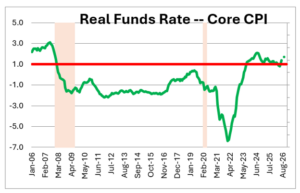
Another way of looking at the funds rate is in “real” or inflation adjusted terms. Today the funds rate is 3.6%, the core PCE inflation rate is 3.3%. Thus, the real funds rate currently is +0.3%. With a 0.5% increase in the funds rate by yearend and little change in the core funds rate, we expect the “real” inflation rate to be +0.6% at yearend. But historically, the real funds rate averages about +1.0%. Thus, by yearend the funds rate in real terms is roughly in line with its historical average. A couple of Fed rate hikes seem unlikely to push the economy over the edge into recession.
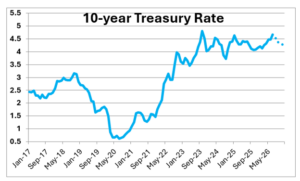
Meanwhile, the yield on the 10-year Treasury note has risen to 4.7% which is on the upper end of where the 10-year rate has been for the past three years. Part of the recent increase reflects the likely increase in the inflation rate caused by higher energy prices. It probably also reflects some concern about the overwhelming supply of Treasury securities required to finance a steady diet of $2.0 trillion budget deficits every year for the foreseeable future. But is this level for the 10-year too high?
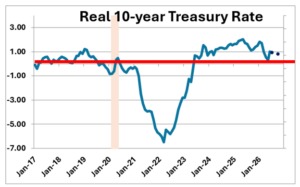
Perhaps the best way to answer that question is to look at the yield on the 10-year note in “real” terms. Today the 10-year note yields 4.7%. The core inflation rate is 3.3%. Thus, the “real” 10-year rate is 1.4%.
Historically, the “real” 10-year averages about 1.0%. In other words it averages about 1.0% higher than the inflation rate. If the core inflation rate is relatively steady between now and yearend the 10-year yield might drop by 0.25% or so to 4.25% which would lower the “real” rate to 0.7%. In other words, do not expect long rates to decline much in the second half of this year.
Anticipating Fed behavior has gotten more challenging since Fed Chair Warsh has arrived. He says he is intent on reducing inflation to the desired 2.0% pace. But he and his colleagues chose not to raise the funds rate at their meeting this week. That kind of reduces his credibility. How serious is he? At the same time he is adamant about not providing “forward guidance” about the likely path of monetary policy. He says he wants to rely on information provided by the markets to help guide policy rather than the other way around.
Hence, we have discussed the funds rate and 10-year rates in “real” terms to see what the markets imply about the current level of rates. Warsh might also look at the yield curve and the futures markets for the markets’ expectations about the funds rate. Fed behavior is clearly changing. But there are a lot of smart economists and market participants out there who can quickly figure out the likely course of interest rates without help from the Fed.
From 1980 until his retirement in 2003, Stephen Slifer served as chief U.S. economist for Lehman Brothers in New York City, directing the firm’s U.S. economics group while also being responsible for forecasts and analysis of the U.S. economy. He has written two books on using economic indicators to forecast financial markets and previously served as a senior economist at the Board of Governors of the Federal Reserve in Washington, D.C. Slifer can be reached at www.numbernomics.com.
F